There’s nothing worse than when you’re just done ad libbing a beautifully constructed example and a student tells you that they ‘don’t get it’ or your perfectly planned and typed WAGOLL isn’t quite getting the reception you’d hoped for. Overcoming these sometimes-unexpected hurdles mid-lesson can be quite daunting, right?
Not to mention those moments when little Bobby, who you haven’t seen in God-knows how long, appears out-of-the-blue and expects you to catch them up on the umpteen lessons they’ve missed in which you’ve covered everything from the basics to the down-right detailed theory behind the writer’s methods.
Here’s where a cheeky little Teacher Exercise Book comes in handy…
I originally started using a TEB with a low-ability, excrutiatingly-chaotic year 9 class at the beginning of my career. My classroom had, at one stage, become a revolving door, a one-in/one-out system of behaviour, attendance and additional intervention. This constant movement in the class makeup meant that I was always having to regurgitate information or staring into a sea of blank faces or even telling the good old lie ‘I’ll only say this one more time’, and quite frankly I became sick of it. Desperate, I decided to start a teacher version of what I expected to see in their books and at first it was like pulling teeth; I wrote down everything from the date/title to the class created WAGOLL.
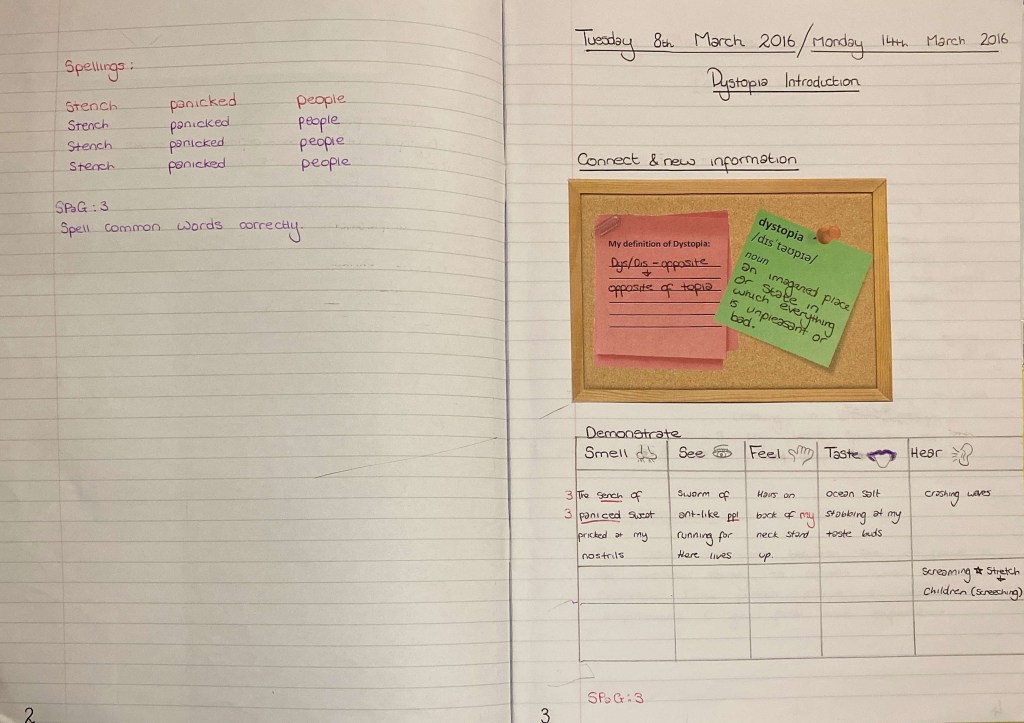
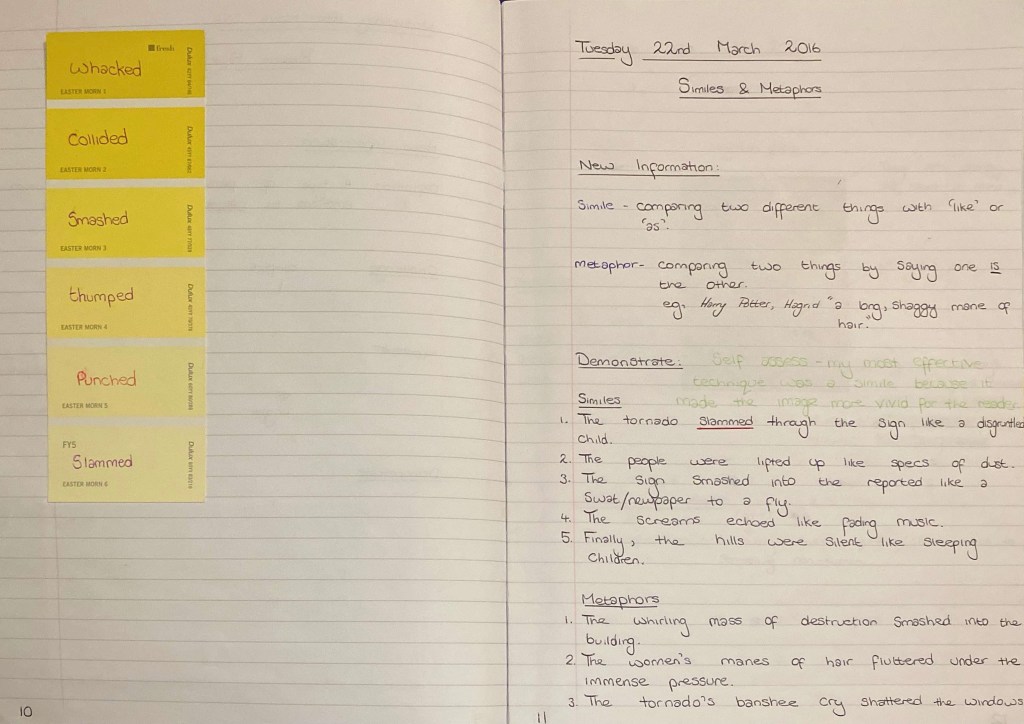
Over time, I have been asked questions about who to use the TEB with, and often the assumption is that it is only necessary with low attaining students. Yet, I have found the TEB to be benefical for all students, regardless of attainment status or additional need. Whilst they are an extremely supportive tool when attempting to model question types, they are also useful for classroom management and modelling expectations in terms of pride in work or standard of work completion. I firmly believe that the moment students begin to take pride in their work is the moment they start to absorb the information they need to succeed. And no, before someone says it I don’t mean beautiful handwriting or pretty highlighted titles, I mean the clear and focused presentation of their thoughts and acquired knowledge.
Now, the success of a TEB does come hand-in-hand with my expectations of the activities that I set each class. As pretty much every teacher has done, as a rite of passage into the profession, I used to spend hours designing fun and engaging card sorts, class games, quote hangers, etc. But after discovering that I couldn’t cut out in a straight line and that I was spending far too much energy on designing the latest game, I realised that although these activities were awesome in short, meaningful bursts, they were not appropriate for my day-to-day practice. And so, I stripped back my lessons to the essentials and ensured that anything I was requiring students to commit to paper was logical and helpful for revision purposes, thus creating student revision guides rather than student exercise books and with that the TEB followed suit.
Since the inception of my TEB practice, I have developed my craft some what and have tailored each one to suit the needs of indivdual classes. For some, I have found that a more detailed approach is necessary to ensure consistency in understanding and skill.

Whilst others simply need it as a quick-check for what they’ve missed or to model annotation skills…
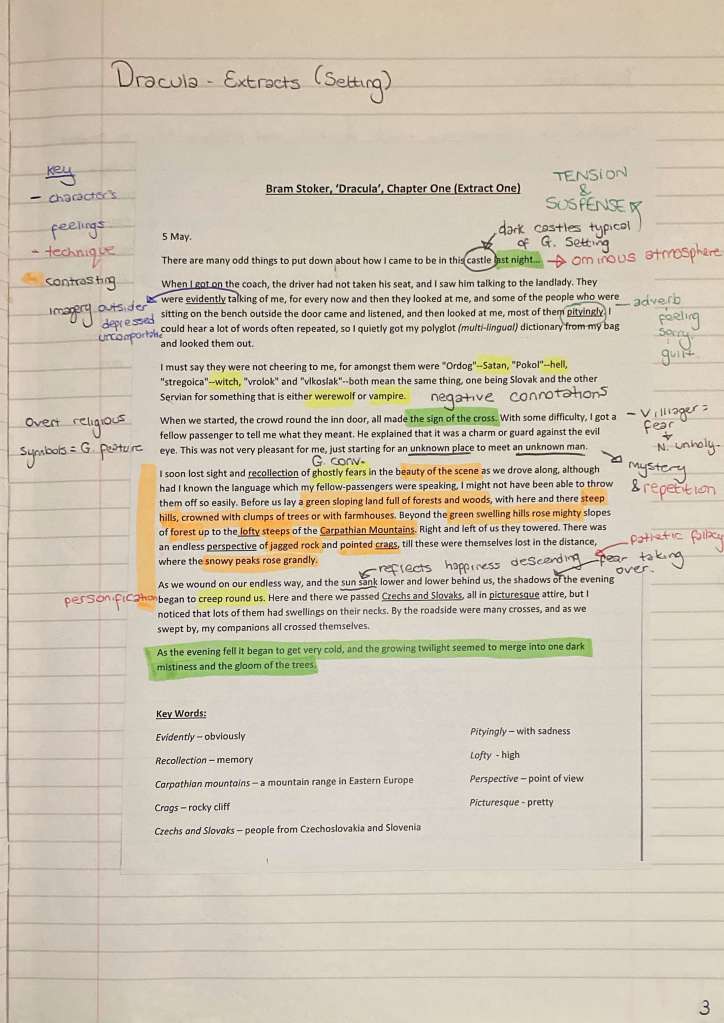
Fast-forward to 2021 and here I am with a TEB for every class and even two for the Key Stage Four classes to spilt the literature and language components of the GCSE exam. I couldn’t recommend doing this enough, but as always there is a word of warning first…
Having and upkeeping a TEB for each of your classes can be front-loaded in terms of workload (setting the lesson up in advance etc.) but the progress in student independence and understanding is unparrelleled, not to mention how much easier it is to deal with persistent absenteeism.
To this day I still set up the book as if it is a revision guide, with a contents page and glossary, mirroring the student books. On occassion I do simply use them to model a single activity for that lesson which works just as well as a full-fledged lesson layout because students understand the process and how to locate the information and what to do with it.
Now, although I adore a good PowerPoint – especially ones with PNG images and no white backgrounds, I have found in the last couple of years I spend a far greater portion of my lessons under the visualiser than I have using my fancy finger-ring clicker. If I’m completely honest I much prefer it this way as lends to a much more in-action reactive environment in the classroom. A student struggling doesn’t have to wait whilst I pull down and adapt the PowerPoint or try to absorb every word of my verbal explanation, instead they can work with me whilst I aid them in becoming unstuck and when I walk away it is still there for them to refer back to.
So, yes whilst I would completely back geeking out and buying yourself a snazzy fancy finger-ring clicker and beautifying those PowerPoints. I would genuinely suggest a TEB to anyone wanting an almost-stress-free, purposeful learning environment that aids students in becoming more independent with missed-work or setting standards for classroom expectations.
 A Scouser's Guide to Education
Thanks for sharing this Miss Hale. This is a great way to reflect on how a teacher organizes lessons new and old by considering how students use it.
LikeLike