Here’s where you are hoping that I give you the golden egg of creative writing, but unfortunately that is not how this cookie is going to crumble. I am not here to profess an uncanny talent for getting students full marks on Section B of the creative writing exam, I simply want to share some of the things I do, that I think work in case it sparks inspiration for your next lesson.
I don’t know about you lot, but I often dread the idea of explicitly teaching creative writing and it’s not because I don’t like it, because I do love it – I love the excitement students have for creating these alternative universes. It’s because I’m always stumped with where to begin. I kind of just want someone to provide me with an all singing, all dancing scheme that does it for me and yes, I am being lazy, but I just don’t have the energy for it sometimes. Now, I’m sure at this point I am filling you full of high expectations for what I have to offer…
But hopefully you are someone who, like me, has sat through all of the very expensive, exam board-provided CPD and still walked away feeling lost at what you are going to take back to your team. And maybe, just maybe, something I share will make you feel less lost, less alone and less defeated. So, let’s get to it…
Tip 1: Go rob some freebies from Dulux
Now, before you judge and call me a ‘typical scouser’, I use the term ‘rob’ lightly – you are allowed to take the sample swatch thingies, maybe not in excessive numbers but a few trips should do it. You know the ones I mean? Those little cards with the fascinating names on them like ‘dead salmon’ or ‘custard cream’.
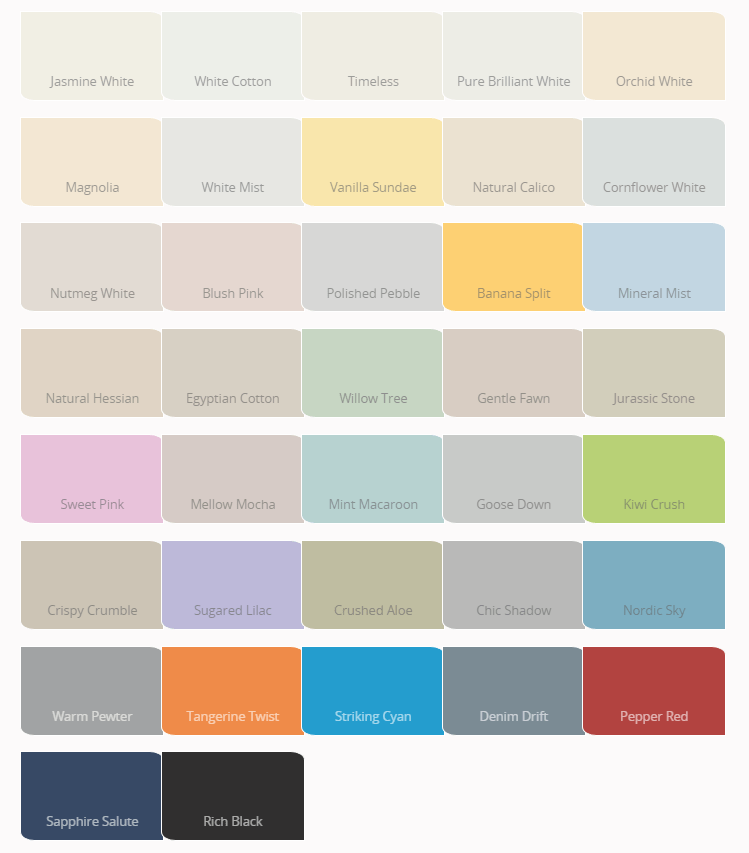
They used to be much better when they did them in graduating colour strips but clearly Dulux are not all for making teacher’s lives easier and switched to these individual cards. But that’s by-the-by.
The way I use them is to bunch them together in general colour groups on a big keyring – I have Tupperware boxes full of them (sorry Dulux).
After asking students to describe something using all their senses (I tend to use photographs for this), I do a recraft/redraft lesson in which I introduce my stolen goods. I explain that their use of colour (we all know there will be that one kid that hasn’t used a single colour reference AT ALL) is subjective – what they think of when introduced to the colour blue isn’t necessarily what I think of when I hear the colour blue. I say ‘imagine I can’t see the image behind me. If you had to describe it to me, how would you tell me what blue the sky is?’
I ask them to the go and find the colours they intended when they used the words ‘blue’ or ‘yellow’ or ‘brown’ etc. I then ask them to directly replace thier original colour with thier new one, for example:
The blue sky hovered above us.
The mineral mist sky hovered above us.
Now as you can see this doesn’t always fit perfectly, on this occasion the forced approach makes it seem almost nonsensical. For this reason, I then direct them to rewrite their sentence to make it fit or pick a new colour:
Like a mineral mist the sky hovered above us.
Not the best, but it’s certainly getting there. At this stage students usually introduce a simile to try and explain what it is they mean exactly and with this they start to create a picture. Don’t get me wrong, not all of the colours work, so be thoughtful in your selection of ones to rob, but the majority of them work well.
I found that once they are used in this way, students tend to ask to use them for other creative writing pieces and begin to build a wider bank of colour vocabulary. You begin to see less and less blue skies, green gardens and yellow suns.
Tip 2: The five-minute story
This is the ‘mean’ teacher in me coming out, but I absolutely love this one and it works every time. Best part about it is there is barely any front-loaded planning for it.

This lesson starts with a five-minute story. Simply students have to write a full-on story in just five minutes. However, there are a few rules:
- No planning
- No distraction
- No stopping writing
- No proof-reading
Although the majority of our students don’t plan anyway, I always find there this a great deal of shock with that first rule, as if they’re being hard done to; the unjustness of the situation is ludicrous!
They panic, write absolutely appalling drivel – just as expected. The catch is though, I do it with them and I include all the common errors, including the famous ‘repetitive I’.
Students love laughing at our expense and there’s no better way to achieve this than a god-awful story, because we’re meant to be amazing writers because we’re English teachers.
What this does, is emphasise the importance of planning and demonstrates quite clearly the common errors they make. Once written I ask them to self-assess their work looking for the common errors:
- Loss of punctuation (dont instead of don’t)
- Repetitive I
- And then…
- Overuse of unnecessary ambitious vocabulary
- The cliffhanger
- Rushed action
- The seven million characters
Once this is done and we’ve all had a good giggle, we begin to work backwards. We use a story arch to work out what it is we wanted to achieve and how their stories need to develop. Then we consider what worked well in our stories and pull those bits out. We also work on our ‘banned list’ – a list created specifically for that class with all the things that they do, their go-to cliches, that are just abysmal and need to be left well alone.
Finally, before running off and redrafting the whole thing again, we talk about ‘working plans’ instead of bolt-ons to impress the examiner and play around with sentence types (such as the carefully constructed sentences or snazzy sentences floating around Twitter at the moment). We take the first sentence (or two, depending on length) and we redraft it five times, getting used to different ways to construct the same sentence.
And voila, students are now slowing down and thinking through exactly what it is they want to say. Stopping to check the story arch and considering a cyclical structure to round their pieces off. Like magic.
Tip 3: In The Picture…
As an ex-AQA teacher and examiner, it’s easy to admit that I miss the picture stimulus for Language Paper 1, Section B. Eduqas, much to my dismay, give students the option of four titles – two of which I would advise students to avoid like the plague. This black and white, letters on a page task lacks inspiration or thought-provoking ideas.
In an attempt to inject engagement and excitement back into the writing section, I decided to steal a few old AQA tricks to get the creative juices flowing.
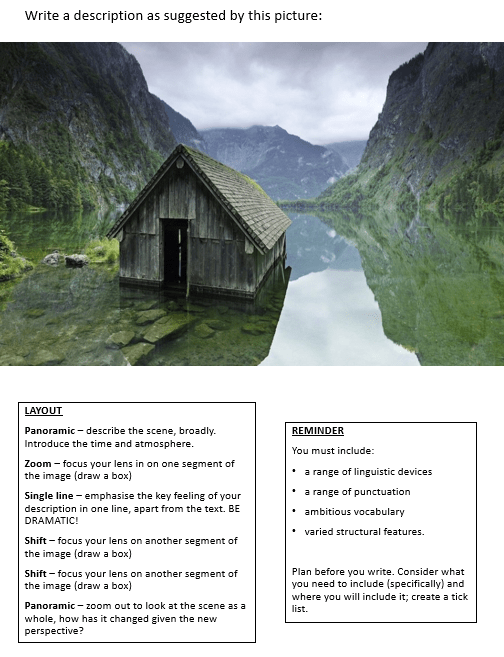
When I first introduce this to my students, we talk about what we can see and generate ideas as a bigger group. By doing this, I am able to demonstrate taking a basic idea e.g., ‘battered’ and playing around with that idea or word and build it into something else e.g., what do we mean by ‘battered’, how so?
This then translates into more ambitious vocabulary and fleshed out ideas. It gives students a starting point that feels safe and doable – all of a sudden, those WAGOLLs now seem achievable.
If students are still struggling to generate ideas, I often pull it back and box the image; simply taking sections of the pictures and drawing a box round small sections – nothing in particular, just boxes on colours and ink. This will help focus their description and concentrate on the intricacies of language rather than complicated storylines and unnecessary character references.
This leads me to my next tip…
Tip 4: Steal Ideas
One of the saddest things about our profession is the ‘forgetting curve’ – no matter how hard we try, how passionate we are, how invested in the story we are, our students will always forget those fascinating moments in those beautiful stories.
A few years ago, I was stuck in a rut of asking students to draw inspiration from the stories they know, not taking those without access to literature into account. I realised that my way was getting us nowhere, well actually worse than nowhere, a complete and utter blank space of nothingness.
What if I gave them the inspiration they needed to succeed? What if I kept exposing them to different forms of beautiful literature? What if I gave them the tools to steal?
I started doing just that, mixing in a bit of the AQA picture-inspired influence. The results were delicious.
Most recently, I was looking at how students should approach the title ‘Grandma’ and decided to merge the two approaches. We started the lesson by looking at an image of two elderly people, presumably a couple. At first, we simple ‘word-vomited’ ideas and then began to progress those ideas by thinking of alternative vocabulary and extending sentences. That then led us on to the requirements of the question before looking at a ‘WAGOLL’ in the form of other literature. We annotated and discussed how Andrew Waterhouse developed the image of a grandfather in ‘Climbing My Grandfather’, giving students a catalogue of language and imagery to use.
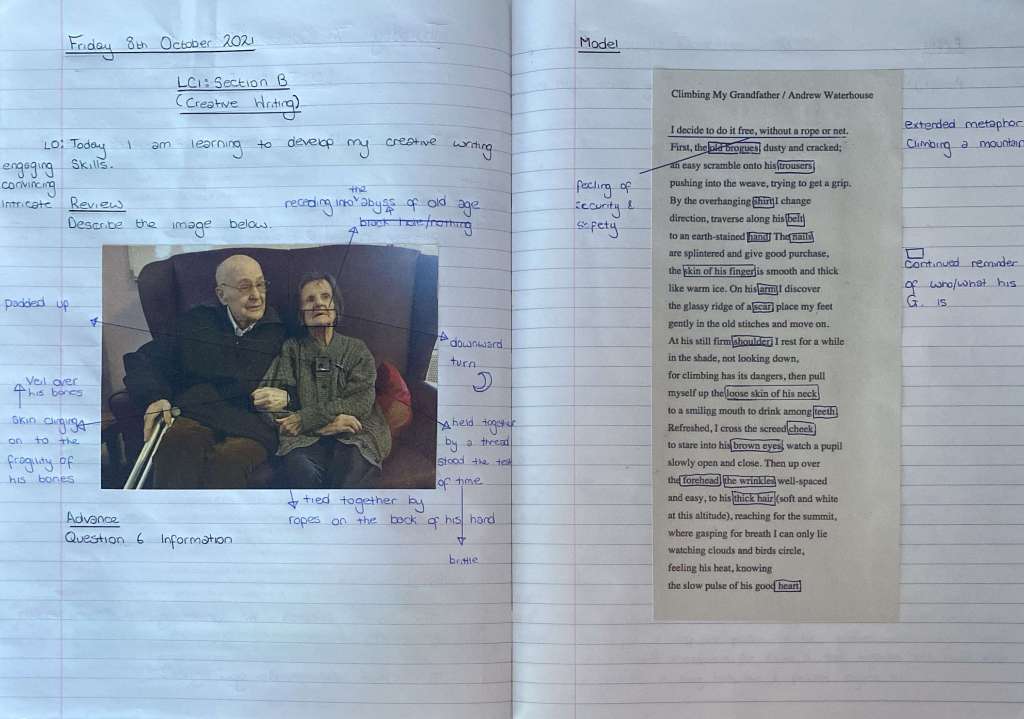
This resulted in some beautifully constructed, thoughtful pieces from students. Giving me the confidence and trust in this approach to teaching creative writing.
As time goes on, I will add more tips and tricks for approaching creative writing, once I’ve tried and embedded them into my practice first to ensure they are useful and concise. For now, I hope that you have found something useful in this blog that brings ease and excitement to your classroom.

